Introduction
TL;DR: shortcut for the impatient reader
Quickstart: gentle introduction for the beginner
TEI Publisher reference manual covers various aspects and technical layers of creation, customization and maintenance of publications based on data encoded primarily in XML. In particular, but not exclusively, we will be discussing scholarly publications based on data encoded in TEI.
This introductory chapter provides a gentle overview of motivations and rationale behind Jinks and TEI Publisher design. For hands-on, technical discussion of particular topics, skip directly to the relevant chapters.
Bridging the gap between a computer-processable representation of sources and tangible, published edition is not a trivial step. It involves precise analysis and modeling, tedious work, and careful orchestration across multiple layers of the technological stack. From the raw data, to the publication - be it an online website or a printed volume - there are many ways to approach the challenge from the technical perspective. For the scholars and content curators, the challenge is rather seen as an obstacle: lengthy, cumbersome and risk-laden but unavoidable process.
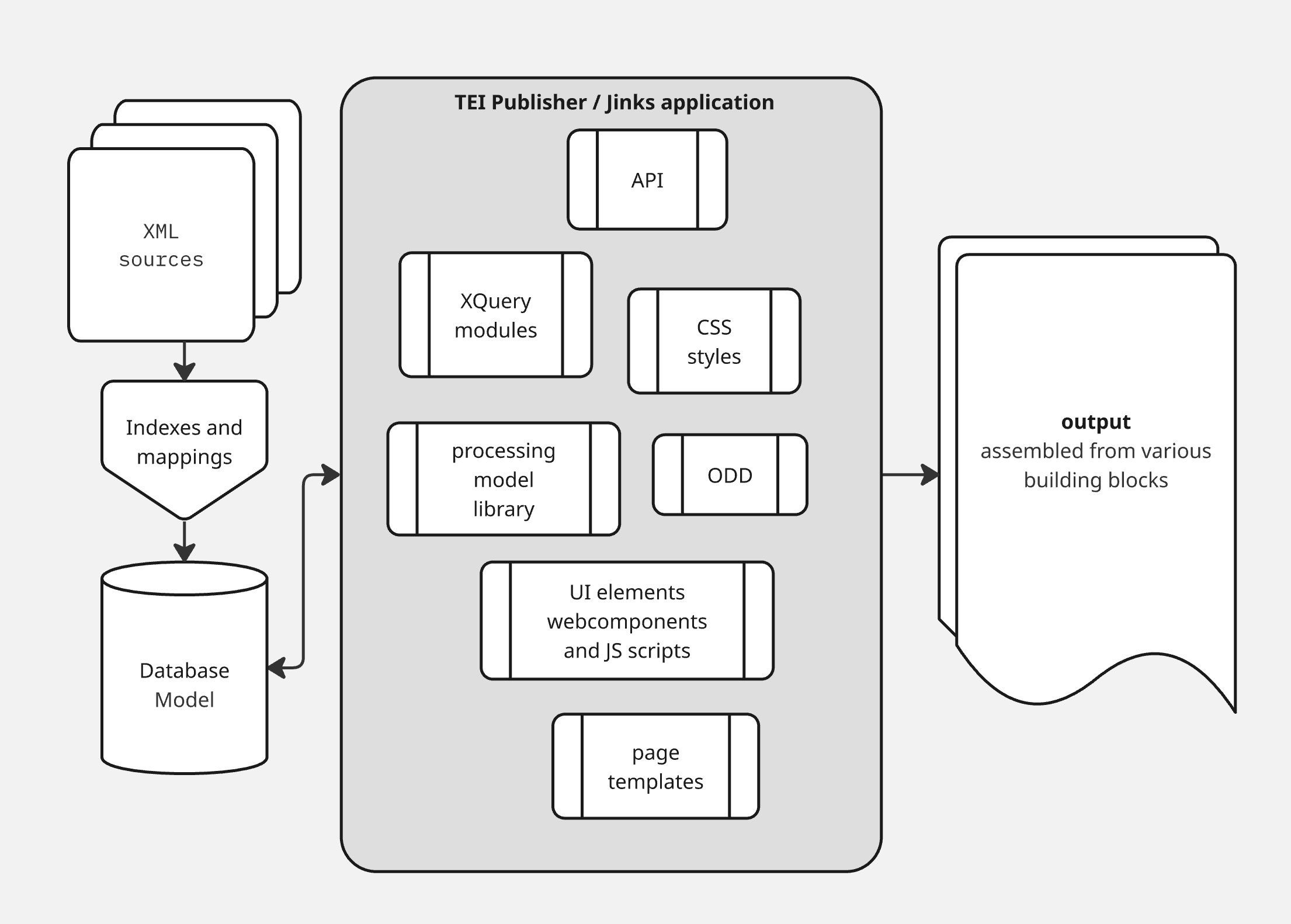
It's not easy to find a way to reconcile the variety and allow for the flexibility within a shared, standards-based framework. From afar, there are significant overlaps between all scholarly publications. Yet the closer we look, the more we notice differences, from subtle to quite fundamental. After all, where is the common ground between a collection of Renaissance correspondence, Buddhist inscriptions, anthology of inaugural poems, and a lexicon of ancient individuals, of whom we only know a few words from their tombstones? Is there a way to accommodate the needs and wishes of editors, at the same time taking into account the technical and economic sustainability, as well as future re-use and interoperability of the scholarly datasets?
The motivation behind TEI Publisher was to provide a tool which enables scholars and editors to publish their materials without becoming programmers, but also does not force them into a one-size-fits-all framework. The solution is based on several foundational principles:
- divide and conquer
-
Split complex problems into smaller tasks. This is reflected in modular design at all levels.
- do not reinvent the wheel
-
Interface with existing systems and libraries where solutions already exist.
- standardize where you can
-
Based on open standards: from well-documented XML vocabularies (like TEI, JATS, DocBook) and formats (JSON) for the representation of data, to support for widely used protocols and specifications (e.g. Open API Specification, IIIF, DTS).
- customize where you must
-
Never force a concrete solution: all elements are designed as customizable.
- community-driven
-
TEI Publisher framework features and components are a response to real needs of user community: developed to provide a generalized solution to a repeated practical requirement.
- open source
-
All components are released under open licenses, assuring that all work continues to benefit the entire community.